Hyperliquid Perps vs. Spot: What's the Core Difference?
Hyperliquid Perps vs. Spot comes down to one question: are you trading a contract or buying the asset? Both markets run on the same Layer-1 app chain and the same central limit order book engine — the difference is entirely in what you end up holding.
Perps (perpetual futures) are synthetic derivatives with no expiry date, built for leverage, short-term speculation, and hedging. Spot is a direct token purchase — you own the underlying asset, full stop, with none of a Perp's ongoing mechanics.
That single distinction cascades into everything else: leverage availability, liquidation risk, ongoing costs, and even which order types you can use. The right choice depends on your holding horizon, not which market has "better" fees.
Perps vs. Spot: Side-by-Side Comparison
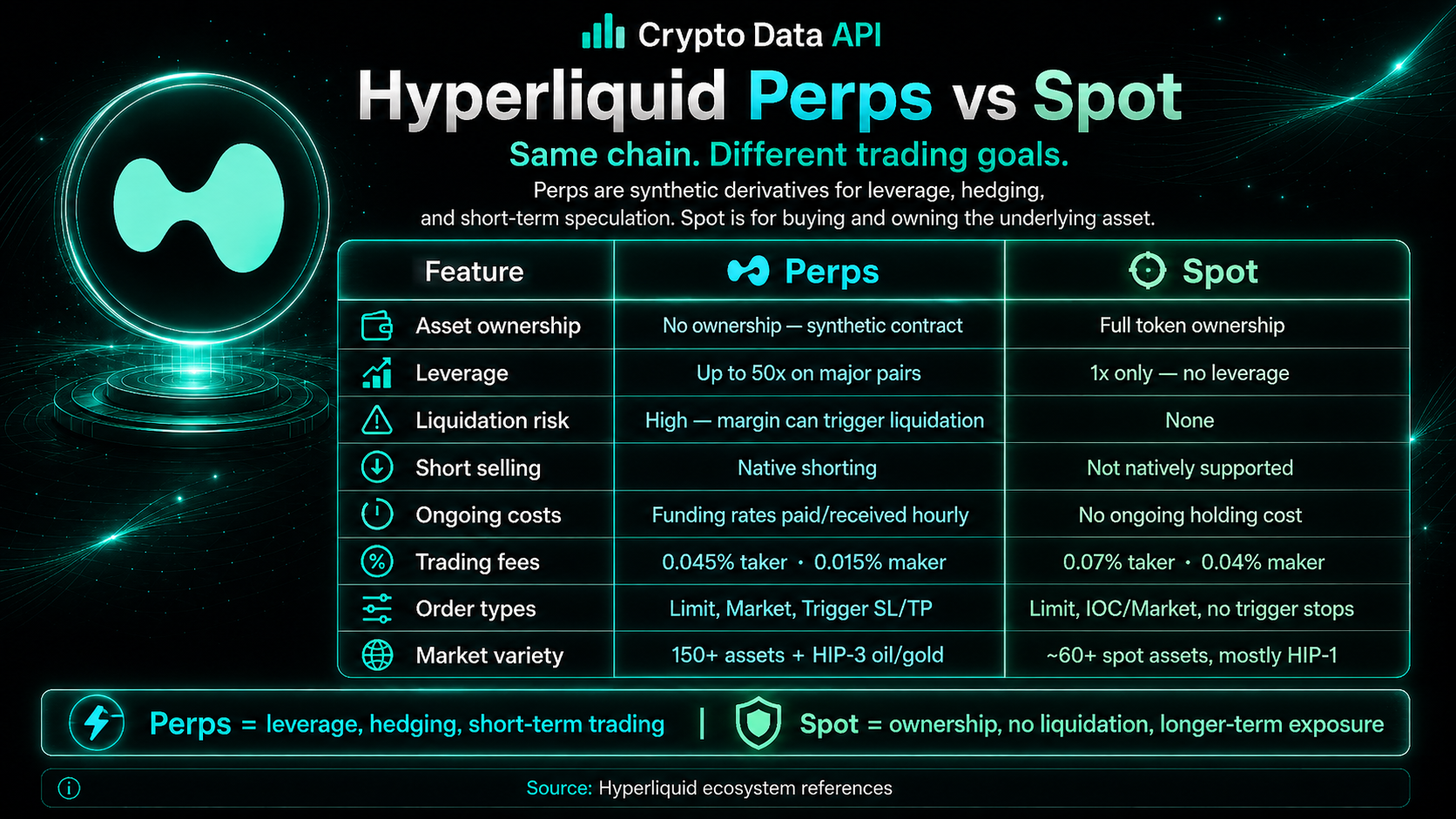
The mechanical differences, confirmed against Hyperliquid's own fee schedule and documentation:
| Feature | Perps | Spot |
|---|---|---|
| Asset ownership | None — synthetic contract | Full ownership of the token |
| Leverage | Up to 50x on major pairs (BTC, ETH) | None — 1x capital only |
| Liquidation risk | High — position closes if margin falls | Zero |
| Short selling | Native | Not natively supported |
| Ongoing costs | Hourly funding, paid or received | None to hold |
| Trading fees | 0.045% taker / 0.015% maker | 0.07% taker / 0.04% maker |
| Order types | Limit, market, trigger stop-loss/take-profit | Limit, IOC/market — no trigger stops |
| Market variety | 150+ assets, plus HIP-3 commodities (oil, gold) | ~60+ assets, mostly HIP-1 tokens |
One detail that changes the fee math: Spot volume counts 2x toward your fee-tier progression, so $1M of Spot volume earns the same tier credit as $2M of Perp volume. Active Spot trading pulls your Perp fees down faster than trading Perps alone — the two markets share one volume-tier ladder, not two separate ones.
The Unified Account Trap: How Spot and Perp Balances Interact
By default, Hyperliquid runs a Unified Account: your USDC is a single capital pool shared by both markets, not two separate wallets. Spend it on Spot and it's gone from that pool; open a Perp position and whatever USDC remains becomes your margin.
- A losing Perp position draws down shared collateral — it can leave you without free USDC to buy Spot, even if you never intended to touch your Spot allocation.
- Margin calls don't ask which market you meant to fund. If free collateral falls too far, the Perp position gets liquidated regardless of what else is sitting in your account as Spot holdings.
- Manual Mode isolates the two. Traders running both strategies at volume typically switch to Manual Mode so a Perp drawdown can't eat into capital earmarked for Spot, and vice versa.
This is the single most common way new Hyperliquid users get surprised — not by a bad trade, but by a good Spot position sitting untouched while an unrelated Perp position quietly liquidates for lack of margin.
What Is the Perp Funding Rate, and Why Doesn't Spot Have One?
A Perp contract has no expiry, so there's no settlement date to force its price back to the real market. Instead, Hyperliquid pays an hourly funding rate between longs and shorts to keep the Perp price tethered to spot.
- Positive funding: longs pay shorts — typical when the market is bullish and Perp demand pushes the contract price above spot.
- Negative funding: shorts pay longs — typical during sustained bearish pressure.
- It compounds hourly, both ways. A long held through a strong bull run can bleed a meaningful amount in funding even while the position is profitable on price alone.
Spot has none of this. Buy the token and the only cost is the one-time taker or maker fee on entry and exit — nothing recurs while you hold. That's the trade-off for giving up leverage and short selling: Spot is the cheaper choice for a multi-month holding horizon, and Perps are the cheaper choice for a multi-hour one.
Order Types: Why Perps Support Stop-Loss Triggers and Spot Doesn't
Hyperliquid was built as a derivatives engine first, and it shows in the order types each market supports:
- Perps: limit, market, and trigger-based conditional orders — stop-loss and take-profit orders that fire automatically when price crosses a level, even while you're offline.
- Spot: limit and IOC/market orders only. There's no native trigger stop-loss — the closest equivalent is a resting limit sell order, which only fills at your chosen price and won't chase price down in a fast move.
Practically, this means Spot holders manage downside by position sizing and resting limit orders, not automated triggers. If you need a hard, automatic exit at a specific price, that's a Perp-market feature — not a gap you can close on the Spot side with a different order type.
Which Should You Choose: Perps or Spot?
The decision maps cleanly onto holding horizon and risk tolerance — not onto which asset you're trading:
- Choose Perps if you want to day-trade market swings, hedge an existing portfolio, profit from a decline by shorting, or need leverage for capital efficiency on a short-term horizon.
- Choose Spot if you're investing on a multi-month-plus horizon, want to accumulate native ecosystem tokens (HIP-1 assets), want zero liquidation risk, or want to avoid funding fees entirely.
Two questions settle most of the ambiguity: are you trying to catch a swing or build a position, and are you trading a major asset (BTC/ETH) or a Hyperliquid-native token that may only exist on the Spot side in the first place. Some newer ecosystem tokens launch Spot-only, with no Perp market yet listed.
Check Live Funding and Open Interest Before You Choose
The Perp-vs-Spot decision shouldn't be made on the general rule alone — the current funding rate on the specific asset you're trading tells you whether Perps are cheap or expensive to hold right now.
curl -H "X-API-Key: YOUR_KEY" \
  "https://cryptodataapi.com/api/v1/hyperliquid/funding-rates?coin=BTC&limit=24"

{
  "coin": "BTC",
  "current_rate": 0.0000375,
  "history": [ { "time": "...", "funding_rate": 0.0000412 }, ... ]
}
A small positive rate held over weeks adds up; a spiking rate is often a sign the Perp is crowded on one side and due for a squeeze. Pair it with open interest to see how much leveraged exposure is actually sitting behind that funding number:
import httpx

headers = {"X-API-Key": "YOUR_KEY"}
base = "https://cryptodataapi.com/api/v1/hyperliquid"

funding = httpx.get(f"{base}/funding-rates", params={"coin": "BTC"}, headers=headers).json()
oi = httpx.get(f"{base}/open-interest", headers=headers).json()

print("BTC funding rate:", funding["current_rate"])
print("BTC open interest:", next(c for c in oi["assets"] if c["coin"] == "BTC"))
If funding is elevated and you were only planning to hold for the leverage anyway, that's a signal the Spot side is worth a second look — you give up leverage and shorting, but you also stop paying the fee that elevated funding rate represents.