Hyperliquid Limit Orders vs. Market Orders: What Changes in Fees and Slippage?
Hyperliquid limit orders vs. market orders is the single biggest lever on your entry price and trading costs — bigger than which coin you pick or which venue you compare fees against. Because Hyperliquid runs a Central Limit Order Book (CLOB), every order is either a Maker or a Taker, and the two behave nothing alike.
A limit order rests in the book and adds liquidity — that's a Maker. A market order crosses the spread and removes liquidity immediately — that's a Taker. The distinction drives a real gap in both what you pay in fees and what you risk in slippage.
Limit vs. Market Order Fees, Side by Side
At the base tier (Tier 0), before any volume or staking discounts, the gap is stark:
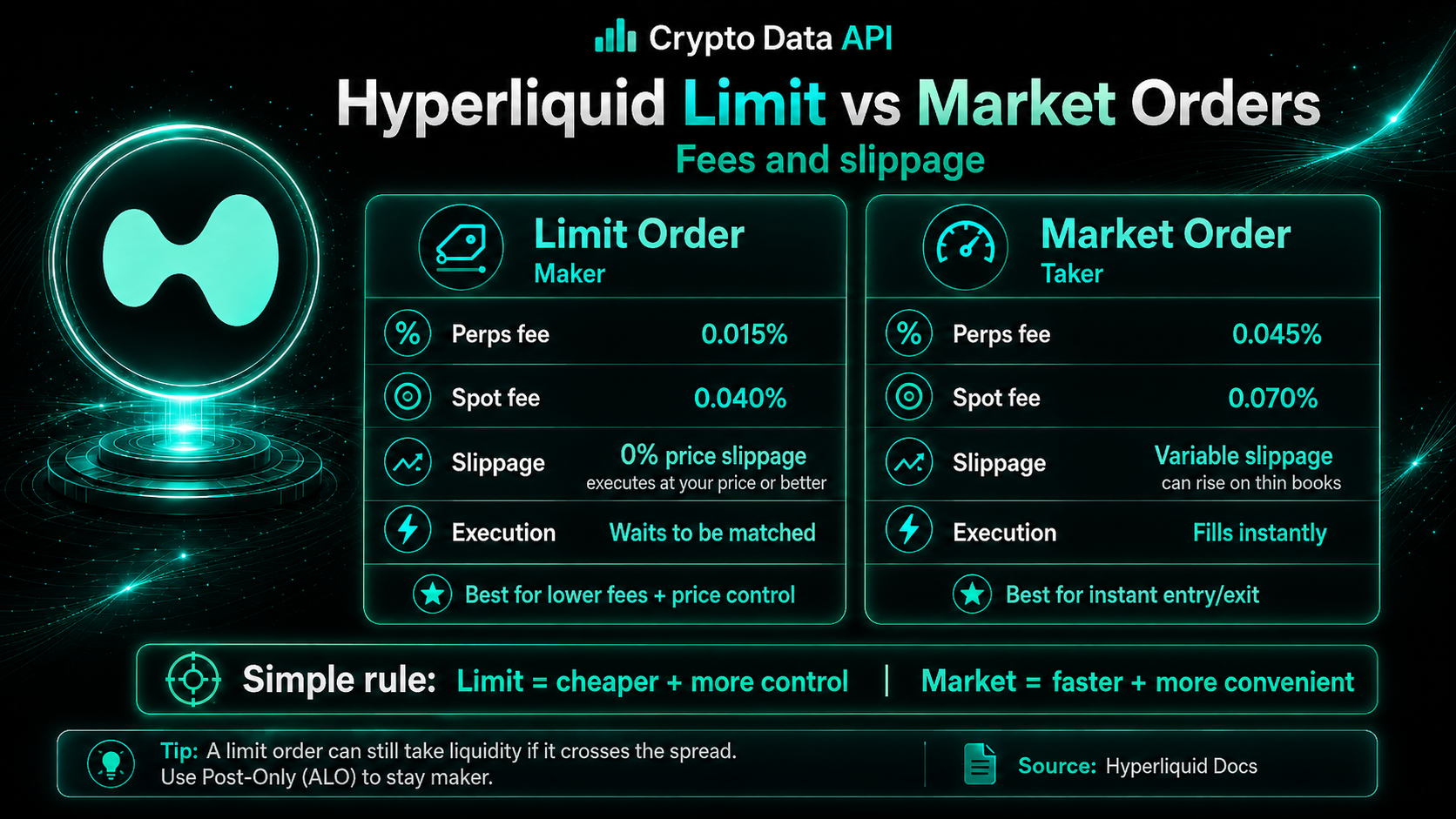
| Metric | Limit Order (Maker) | Market Order (Taker) |
|---|---|---|
| Perpetuals fee | 0.015% (1.5 bps) | 0.045% (4.5 bps) |
| Spot fee | 0.040% (4.0 bps) | 0.070% (7.0 bps) |
| Slippage risk | Zero — guaranteed price | Variable — can be high on thin books |
| Execution speed | Delayed — waits to be matched | Instant — fills immediately |
| Fill guarantee | None — may never fill | Guaranteed — matches the existing book |
On Perps, a Taker pays exactly 3x what a Maker pays — on Spot, the ratio is 1.75x. Neither gap includes slippage, which only ever works against a market order, never a limit order.
How Maker (Limit) Fees Work — and How to Avoid Accidentally Paying Taker
A standard limit order sits in the book waiting to be matched, which is what makes it a Maker order — it adds liquidity instead of consuming it.
- The cost advantage is real money at size. A $10,000 Perp position costs $1.50 to open as a Maker versus $4.50 as a Taker — the same $10,000 trade, 3x the fee, for filling instantly instead of waiting.
- Rebates kick in at volume. Hyperliquid's maker fee schedule turns negative at higher 14-day maker-volume shares — roughly -0.001% at 0.5% of maker volume, -0.002% at 1.5%, and -0.003% at 3% — meaning the exchange pays you to add liquidity once you're a large enough share of it.
- A limit order can silently become a Taker order. Set your limit price aggressively past the current spread and it executes immediately against the book — you get filled, but at the Taker fee, not the Maker one.
To guarantee Maker-only behavior, use Post-Only (ALO — Add Liquidity Only). An ALO order either posts to the book as a pure Maker order or cancels outright — it will never cross the spread and accidentally pay the Taker rate.
How Taker (Market) Fees Work Under the Hood
Hyperliquid doesn't run a separate "market order" matching path — under the hood, a market order is an Immediate-or-Cancel (IOC) limit order placed at an aggressive price boundary far enough through the book to guarantee it fills, fully or partially, right away.
- You pay for the guarantee. 0.045% on Perps, 0.070% on Spot — the premium is the price of not waiting.
- Partial fills are possible. If the book can't absorb your full size at prices you'd accept, IOC fills what it can and cancels the rest rather than chasing price indefinitely.
- There's no rebate tier for Takers. Volume discounts reduce the Taker fee as you climb Hyperliquid's tiers, but it never goes negative the way Maker fees can.
The 3x fee premium on Perps buys certainty of fill and speed — worth it when you need to be in or out now, and an unnecessary cost when you don't.
Why Do Market Orders Slip and Limit Orders Never Do?
A limit order gives you absolute price control: set a buy limit at $60,000 and it only ever fills at $60,000 or better. There is no scenario where it fills worse — the trade-off is the risk of never filling at all if price moves away first.
A market order does the opposite — it walks the book, consuming resting orders at progressively worse prices until your full size is filled:
- On majors (BTC, ETH): order books are dense enough that a $10,000 market order typically slips less than 0.01%.
- On altcoins, or majors during a volatility spike: thinner books mean a large market order can eat through several price levels, producing 0.5% to 2%+ in slippage that never shows up as a fee line item — it's hidden in your fill price.
Hyperliquid shows an "Estimated Slippage" preview before you confirm a market order — on anything outside the top few majors by volume, check it before confirming rather than after.
Minimizing Both Costs: When to Use a TWAP Order Instead
If a position is large enough that a market order would slip meaningfully, but a single limit order risks missing the move entirely, there's a third option: a TWAP (Time-Weighted Average Price) order.
- It slices one large order into many smaller sub-orders, executed automatically at regular intervals over a duration you set.
- Each slice hits the book at a size the book can absorb, sharply reducing the per-slice slippage compared to dumping the full size at once.
- It trades speed for cost, the same fundamental trade-off as limit vs. market, just spread across many small fills instead of one binary choice.
TWAP is the right tool specifically when position size, not urgency, is the constraint — a $500 market order on BTC doesn't need one; a $500,000 market order on a mid-cap alt almost certainly does.
Check Order Book Depth Before You Submit a Market Order
"Will this slip" is answerable before you place the order — pull the live L2 book and walk it yourself the same way the matching engine will.
curl -H "X-API-Key: YOUR_KEY" \
  "https://cryptodataapi.com/api/v1/hyperliquid/l2-book?coin=BTC"

{
  "coin": "BTC",
  "bids": [ { "price": 96100.0, "size": 2.8, "count": 5 }, ... ],
  "asks": [ { "price": 96150.0, "size": 1.9, "count": 3 }, ... ]
}
Walk the ask side (for a buy) to estimate the average fill price for a given USD size, and compare it to the best ask to see your expected slippage before you submit anything:
import httpx

def estimate_slippage(coin: str, usd_size: float) -> float:
    book = httpx.get(
        f"https://cryptodataapi.com/api/v1/hyperliquid/l2-book",
        params={"coin": coin},
        headers={"X-API-Key": "YOUR_KEY"},
    ).json()

    best_ask = book["asks"][0]["price"]
    remaining_usd, base_qty = usd_size, 0.0
    for level in book["asks"]:
        level_usd = level["price"] * level["size"]
        take_usd = min(remaining_usd, level_usd)
        base_qty += take_usd / level["price"]
        remaining_usd -= take_usd
        if remaining_usd <= 0:
            break

    filled_usd = usd_size - remaining_usd
    avg_fill_price = filled_usd / base_qty if base_qty else best_ask
    return (avg_fill_price - best_ask) / best_ask * 100  # % slippage

print(f"{estimate_slippage('BTC', 10_000):.4f}% slippage on a $10k BTC market buy")
If the estimate comes back under a few basis points, a market order's 3x fee premium is a fair price for instant execution. If it comes back in the tenths of a percent or higher, a limit order — or a TWAP for real size — is doing real work, not just saving on fees.