How Do HYPE Staking Rewards Actually Work?
Hyperliquid staking rewards tiers are actually two separate systems that get talked about as one: a passive APY paid in HYPE for delegating to a validator, and a fee-discount tier unlocked purely by the size of your staked balance. Conflating them is why most explainers undersell what staking actually does.
Staking happens natively inside HyperCore, Hyperliquid's onchain state layer — there's no external contract or wrapped token involved. The flow is:
- Move HYPE from your spot balance into a staking balance — a one-way internal transfer, not a swap.
- Delegate that staking balance to one or more validators who run the consensus infrastructure.
- Rewards accrue continuously and auto-compound in HYPE — there's no separate claim transaction.
- Your staking-tier fee discount reads your live staked balance, not a historical snapshot, so it moves the moment you stake or unstake.
Both rewards exist because they're paid for differently: the APY comes from Hyperliquid's protocol-level emission and fee-burn mechanics distributed to stakers, while the fee discount is a product decision to reward stakers with cheaper trading — it costs the protocol nothing per trade, it just reduces revenue on that trader's flow.
Gross Reward Rate vs. Net Reward Rate: What You Actually Earn
The APY advertised for HYPE staking is a Gross Reward Rate (GRR) — the network-wide rate before your specific validator takes a cut. What lands in your staking balance is the Net Reward Rate (NRR):
NRR = GRR × (1 − validator_commission)Two things make this worth checking before you delegate:
- GRR is variable, not fixed. It moves with total network stake — more HYPE staked network-wide dilutes the rate for everyone, roughly the same dynamic as any PoS-style reward pool. Public trackers have shown net rates anywhere from ~1.7% to ~4.5% over 2026 depending on the validator and market conditions — there's no single fixed number to quote.
- Commission is set per validator, and it isn't uniform. Some validators charge close to 0% to attract delegation; others charge meaningfully more. A validator's current commission is visible on Hyperliquid's staking page before you delegate — check it, because a 5-percentage-point commission gap is a 5-percentage-point gap in what you actually keep.
Worked example: at a 2.4% GRR and a 4% validator commission, your NRR is 2.4% × 0.96 = 2.304%. Switch to a validator charging 0% commission and the same GRR nets you the full 2.4% — a real difference with zero added risk, since both validators are delegating the same underlying stake.
The 6 HYPE Staking Reward Tiers: Wood to Diamond
Separately from the APY, Hyperliquid runs six staking-tier fee discounts based purely on how much HYPE you have natively staked — not LP'd, not sitting in a spot wallet. Confirmed against Hyperliquid's own fee documentation:
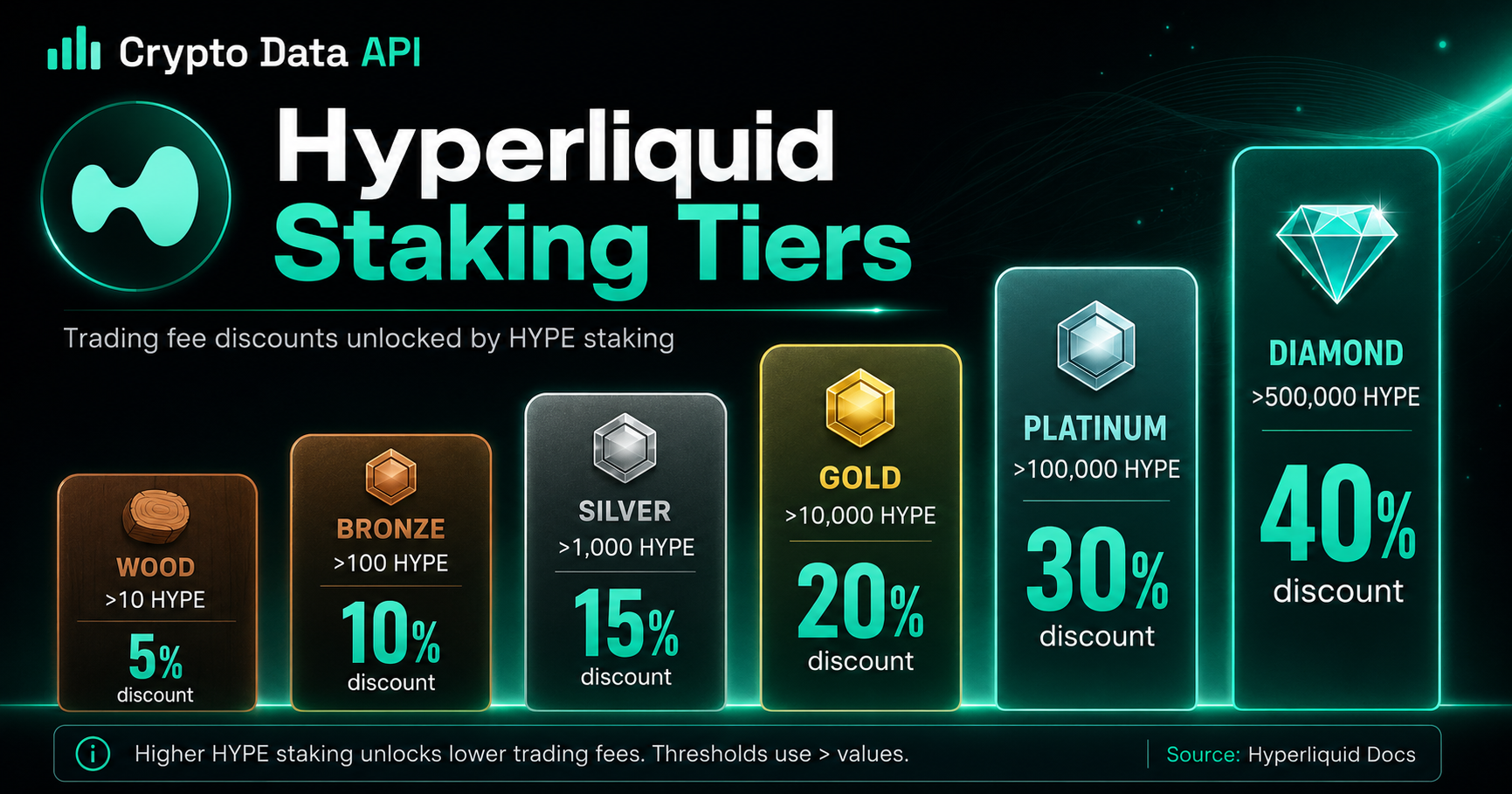
| Tier | HYPE staked | Fee discount |
|---|---|---|
| Wood | >10 HYPE | 5% |
| Bronze | >100 HYPE | 10% |
| Silver | >1,000 HYPE | 15% |
| Gold | >10,000 HYPE | 20% |
| Platinum | >100,000 HYPE | 30% |
| Diamond | >500,000 HYPE | 40% |
The entry point is lower than most people assume — just over 10 HYPE, a few hundred dollars at typical prices, unlocks Wood tier and a 5% discount on every maker and taker fee. There's no re-enrollment: cross a threshold and the discount applies on your very next trade, no application or lockup beyond the normal unstaking queue.
This discount stacks multiplicatively with Hyperliquid's referral discount and volume-based fee tiers, not additively — effective_fee = tier_fee × (1 − referral_discount) × (1 − staking_discount). Drop below a tier's threshold later and the discount stops applying going forward; it doesn't claw back fees you already saved.
How Long Does It Take to Unstake HYPE?
Unstaking isn't instant, and the delay is longer than the headline "7-day queue" most guides quote. It's actually two stages:
- A 1-day lockup once you initiate unstaking — your balance stops earning and stops counting toward a fee-discount tier immediately, but hasn't left the staking balance yet.
- A 7-day transfer queue before the HYPE lands back in your spot balance and becomes tradeable or withdrawable.
That's 8 days total from clicking unstake to having liquid HYPE again. A few operational details worth knowing before you rely on it:
- Each address can have up to 5 pending withdrawals queued at once — useful if you want to stagger unstaking rather than pull everything at once.
- Your fee-discount tier drops the moment you initiate unstaking, not when the queue finishes — don't unstake mid-way through a trading session if you're relying on the discount for that session's volume.
- There's no early-exit fee for the queue itself, but you forgo 8 days of APY accrual on whatever you've unstaked.
Practically: don't stake HYPE you might need liquid within 8 days, and if you're delegating a large position ahead of a known event (an unlock, a rebalance), start the unstake early rather than assuming same-day access.
Choosing a Validator: Commission, Uptime, and Jailing Risk
Hyperliquid has no automatic slashing for HYPE stakers — delegating doesn't put your principal at risk of a protocol-level cut the way some PoS chains work. The real risk is smaller but still worth managing:
- Jailing halts rewards, it doesn't burn stake. A validator that performs poorly — low uptime, missed consensus participation — can be jailed. Delegators to a jailed validator stop earning until it's un-jailed or they redelegate elsewhere.
- Commission can change. A 0% teaser rate isn't locked in; check a validator's commission history, not just its current number, before delegating a large position long-term.
- Concentration is a network-health signal, not just a personal-risk one. Heavily over-delegated validators are a single point of failure for the network's decentralization, separate from whether your own rewards are safe.
None of this affects your fee-discount tier — that's determined purely by your staked balance, regardless of which validator holds the delegation. It only affects the APY leg of the reward.
Staking for Yield vs. Staking for Fee Discounts: Which Should You Optimize For?
The right amount of HYPE to stake depends on which reward actually moves the needle for your account — the two optimize for different behavior:
| Optimizing for APY yield | Optimizing for fee-discount tier | |
|---|---|---|
| Who it favors | Long-term holders, low trading frequency | Active traders, high monthly volume |
| Reward driver | Time-weighted: bigger stake, longer duration | Threshold-weighted: crossing the next tier line |
| Marginal HYPE value | Roughly linear — every extra HYPE earns the same NRR | Zero between tiers, a step-jump at each threshold |
| What breaks the value | Falling network-wide GRR, high validator commission | Low trading volume — a discount on fees you rarely pay is worth little |
The practical takeaway: if you trade less than a few times a month, the APY leg is where the value is — stake as much as you're comfortable locking up for 8+ days at exit, and pick the lowest-commission validator you trust. If you trade frequently, work backward from the tier thresholds instead — staking just past a line (e.g. 10,000 HYPE for Gold) is usually worth more than staking an arbitrary extra amount that doesn't cross the next one.
How to Size Your Stake: Pull Live HYPE Price and Volume Data
Both sides of this decision depend on numbers that move daily — HYPE's price (what a tier actually costs in USD) and your own trading volume (what a fee discount is actually worth). Pull both before committing HYPE to a staking balance for 8+ days.
curl -H "X-API-Key: YOUR_KEY" \
  "https://cryptodataapi.com/api/v1/hyperliquid/prices"

{
  "prices": { "HYPE": 42.85, "BTC": 96120.5, "ETH": 3410.2 },
  "count": 187
}
Multiply the live HYPE price by each tier's threshold to see the real USD cost of Wood through Diamond today, rather than trusting a number that was accurate whenever you last read about it:
import httpx

TIERS = {"Wood": 10, "Bronze": 100, "Silver": 1_000, "Gold": 10_000, "Platinum": 100_000, "Diamond": 500_000}

resp = httpx.get(
    "https://cryptodataapi.com/api/v1/hyperliquid/prices",
    headers={"X-API-Key": "YOUR_KEY"},
).json()
hype_price = resp["prices"]["HYPE"]

for tier, hype_amount in TIERS.items():
    print(f"{tier}: {hype_amount:,} HYPE = ${hype_amount * hype_price:,.0f}")
If you're deciding whether the fee discount pays for itself, cross-check your own recent taker volume against the discount percentage for the tier you're considering — a 20% discount on fees you barely pay is worth less than the opportunity cost of the HYPE sitting locked in an 8-day unstaking queue instead of earning elsewhere.